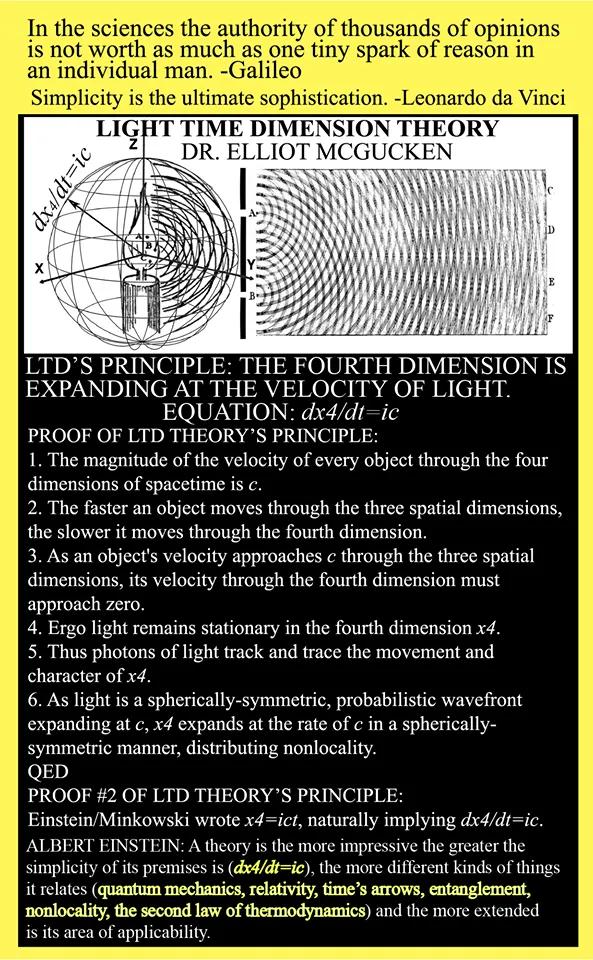
Relativity tells us that the photon experiences no time in its frame. And too, relativity tells us that the photon experiences no space in its frame. Thus, to a photon, the spatial distance between any two points is zero. And too, in the photon’s frame, it takes no time to travel between any two points. Ergo relativity gives us quantum nonlocality and entanglement. Quantum nonlocality and entanglement are found in relativity.
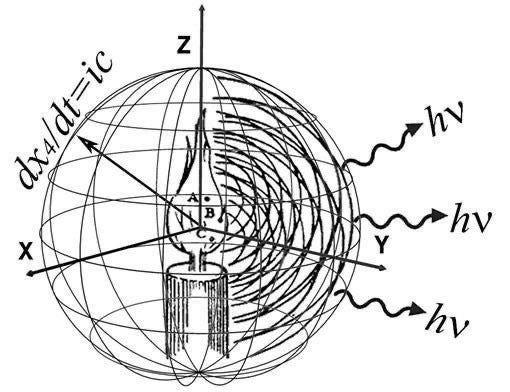
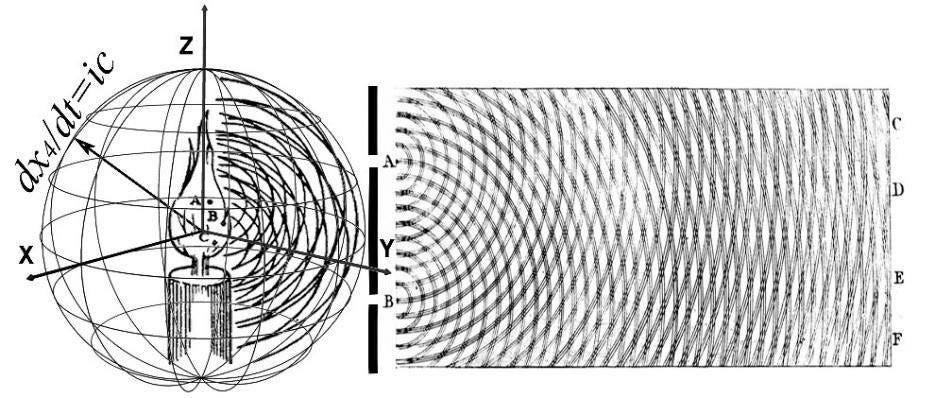
As the photon sees no space nor time between any two points, these points are at the same place to the photon. So it is that within a light sphere, or a McGucken Sphere, there always exists a frame where there is no time nor distance between any two events. Thus, that which is considered “the past,” in any quantum eraser or double slit experiment which takes place within a McGucken Sphere, may easily be considered the present. And that which is considered to be a great distance may be considered to be no distance at all. And so it is that relativity gives us nonlocality, as both relativity and quantum nonlocality rest upon the deeper foundations of a fourth expanding dimension given by dx4/dt=ic. Time and all its arrows an asymmetries are also seen to emerge from this most foundational principle, as is the Second Law of Thermodynamics and Huygens’ Principle which stipulates that ever point on a photon’s wavefront is a sphere expanding at the rate of c, again, as given by dx4/dt=ic
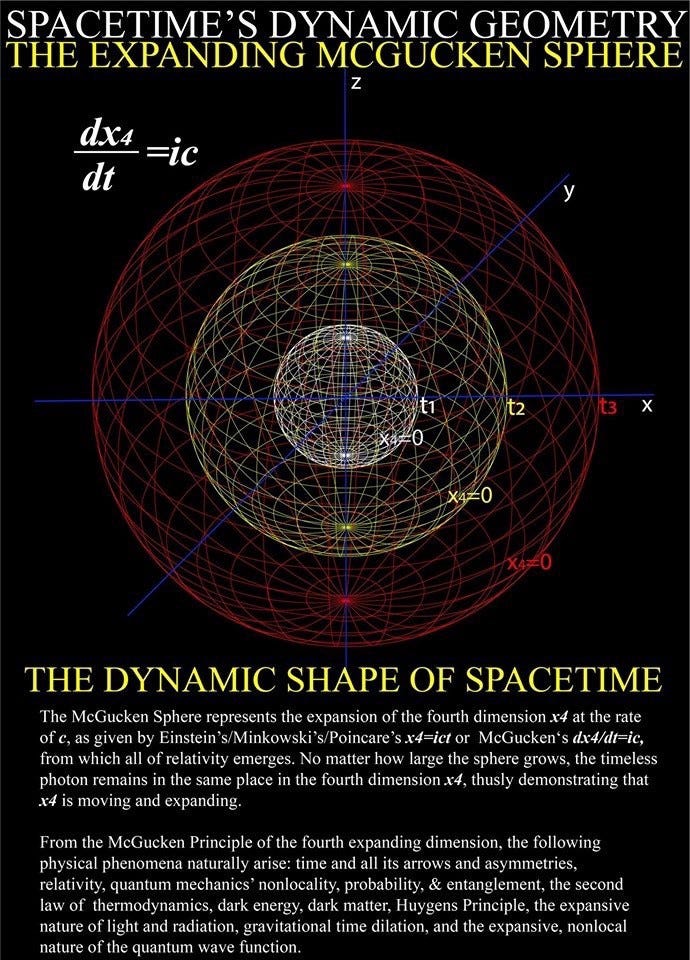
The McGucken Nonlocality Principle: All quantum nonlocality begins in locality.
Locality becomes nonlocality via the expansion of the fourth dimension at the rate of c as given by dx4/dt=ic, which naturally gives rise to Huygens’ Principle, time and all its arrows, all of relativity via the spacetime metric x4=ict, and quantum nonlocality, etanglement, and probability.
The McGucken Principle of a fourth expanding dimension given by dx4/dt=ic predicts that all nonlocality begins as locality.

In the grand endeavor of physics, a physicist observes nature and then composes principles, postulates, and equations reflecting physical reality. Other physicists are invited to disprove the principles, postulates, and equations via mathematics and thought experiments, and/or conduct experiments and make observations that demonstrate the said principles, postulates, and equations to be false.
The McGucken Principle: Quantum nonlocality begins in locality.
The world’s top scientists (and philosophers/quantum computing mavericks) have yet to share how they would go about entangling two unentangled electrons in NY and LA. Please, if they (or anyone) could tell me how they would entangle the two distant electrons, without bringing them in direct, local contact, or by using a system or systems of particles that originated in a local manner with local contact, then I would consider myself defeated in my argument, and I would retract my principle: “ALL QUANTUM NONLOCALITY BEGINS IN LOCALITY.” This provides a direct physical test of the expansion of the fourth dimension given by dx4/dt=ic.
But, if they are unable to explain how they would go about entangling the two electrons in NY and LA without using some form of nonlocality which begins in locality, then SCIENCE and PHILOSOPHY must declare
The McGucken Principle of Nonlocality the victor here.
The McGucken Principle: Quantum nonlocality begins in locality.
If the world’s top quantum physicists are unable to demonstrate that the above principle is wrong in a laboratory, or even in a thought experiment, then, until they falsify it, the principle shall reign. And I will look forward to presenting it at Harvard, Stanford, Yale, the Princeton Institute for Advanced Studies, and the John Bell Institute. Bell, Bohr, and Einstein certainly valued experimental truths, principle, and reality over dogma.
And too, if any of the world’s top physicists came to realize that the McGucken Principle is true, I would certainly love it they joined my in writing papers on it. Contained in the principle is a cornucopia of physical entities and opportunities, including time and all its arrows and asymmetries, Huygens’ Principle, relativity, the very heart of quantum mechanics, and the second law of thermodynamics.
Again, here is the fuller description of the laboratory experiment involving two unentangled electrons in NY and LA:
Consider an electron in a lab in New York electron A and a second electron in a lab in Los Angeles electron B. Both the NY and LA electron’s position, spin, and momentum are being continuously measured, and the NY and LA experimentalists talk on the phone and determine that there is no correlation between the measurements on the electrons. They thus conclude that the electrons A and B are NOT entangled.
If they wish to entangle the NY and LA electrons, they must bring them into direct, local contact, or use some transitive third-party entity or system to entangle the two, whence this third-party element or system must have shared a locality with both particles and with itself, as all nonlocality begins as locality. One possible manifestation of the third-party entity could be electron C and electron D, whence sometime in our lab frame’s past, electron C and electron D were brought into direct, local contact thusly becoming entangled, before being separated with electron C being transported to NY and and electron D being transported to LA, fully maintaining their entanglement.
Then, electron C is allowed to interact with electron A in NY, and electron D is allowed to interact with electron B in LA at the same time. Then, electron A and electron B may become immediately entangled in a nonlocal manner exceeding the velocity of light. But, neverthless, the nonlocality originated in the local contact between electron C and electron D. And thus the principle stands: all nonlocality begins in locality.
I thus stand by the second McGucken principle too:
Only systems of particles with intersecting light spheres, with each light sphere having originated from each respective particle, can ever be entangled.
While the nonlocal influences found in entanglement are instantaneous, the property of entanglement between particles is limited by the velocity of light, as all nonlocality begins as locality.
And too, in addition to the above, I propose that any entangled particles must exist in a McGucken sphere, where the McGucken Sphere is defined as a sphere whose radius expands at the velocity of light c, as given by radius = x4 = ict.
If you would like to refute the fact that all nonlocality begins as locality, please do share how you would entangle the two electrons in NY and LA in a way that is faster than the velocity of light and in a manner which does not involve any instance of nonlocality derived from locality. I hope that you might consider becoming a coauthor!
I am preparing thorough papers on it all. The simple principle has numerous ramifications spanning time’s arrows, relativity, the second law of thermodynamics, and more. If you would like to perhaps be a coauthor, I would be happy to send you a free t-shirt: https://teespring.com/the-chloe-principles-of-physic
As nonlocality grows over time, we can also link nonlocality to time’s arrows and asymmetries. And too, nonlocality may be directly linked to Huygens’ Principle which stipulates that every local point becomes a nonlocal wave. For anyone left refuting the principle that “All nonlocality begins in locality,” please do let us know how you would entangle two unentangled electrons in NY and LA without bringing them in direct local contact, or without using some third-party system that originated locally and which only afterwards came in direct, local contact with the two electrons in LA and NY. More specifically: Dr. McGucken’s two laws of nonlocality:
- All nonlocality begins as locality.
- Nonlocality grows over time, in a manner limited by the velocity of light c.
And:
3. Only systems of particles with intersecting light spheres, with each light sphere centered about each respective particle, can ever be entangled.
4. Any entangled particles must exist in a McGucken sphere, where the McGucken Sphere is defined as a sphere whose radius expands at the velocity of light c, as given by radius = x4 = ict. One may state this as, for any entangled particles, there exists a McGucken Sphere containing the particles.
“More intellectual curiosity, versatility and yen for physics than Elliot McGucken’s I have never seen in any senior or graduate student. . . Originality, powerful motivation, and a can-do spirit make me think that McGucken is a top bet.” –Dr. John Archibald Wheeler, Princeton University’s Joseph Henry Professor of Physics
There exist many excellent books on Quantum Entanglement, but so far, none of them have presented a *physical* means nor mechanism accounting for quantum entanglement.
What is quantum entanglement? Why is entaglement? How is quantum entanglement? All these questions, and many more banished ones, are asked and answered in this revolutionary book which humbles itself before the giants of the quantum ranging from Planck, to Einstein, to Bohr, to Schrodinger, to Heisenberg, to Dirac, to Wheeler, to Feynman.
How is it, exactly, that two photons sharing a common origin can yet remain entangled no matter how far apart they travel? How can two photons separated by the width of our galaxy yet be connected in such a manner so that measuring one of them *instantaneously* influences the other?
While no useful information can yet be transferred faster than the velocity of light, both quantum theory and dozens quantum experiments now exalt the physical effect of entanglement’s instantaneous influence which travels faster than light.
How can this be? What is entanglement’s deeper source? What physical mechanism underlies quantum nonlocality? What foundational physical reality exalts entanglement?
Dr. E turns towards his Princeton days working with the Noble J.A. Wheeler and Nobel Laureate Joseph Taylor, and he invokes the geometry a fourth dimension expanding at the rate of c relative to the three spatial dimensions. The expansion distributes locality into nonlocality, so that even as two photons travel apart from a common origin, they yet remain entangled as they share a common locality exalted by the fourth expanding dimension.
At long last, a *physical* mechanism is presented which accounts for quantum nonlocality and entanglement.
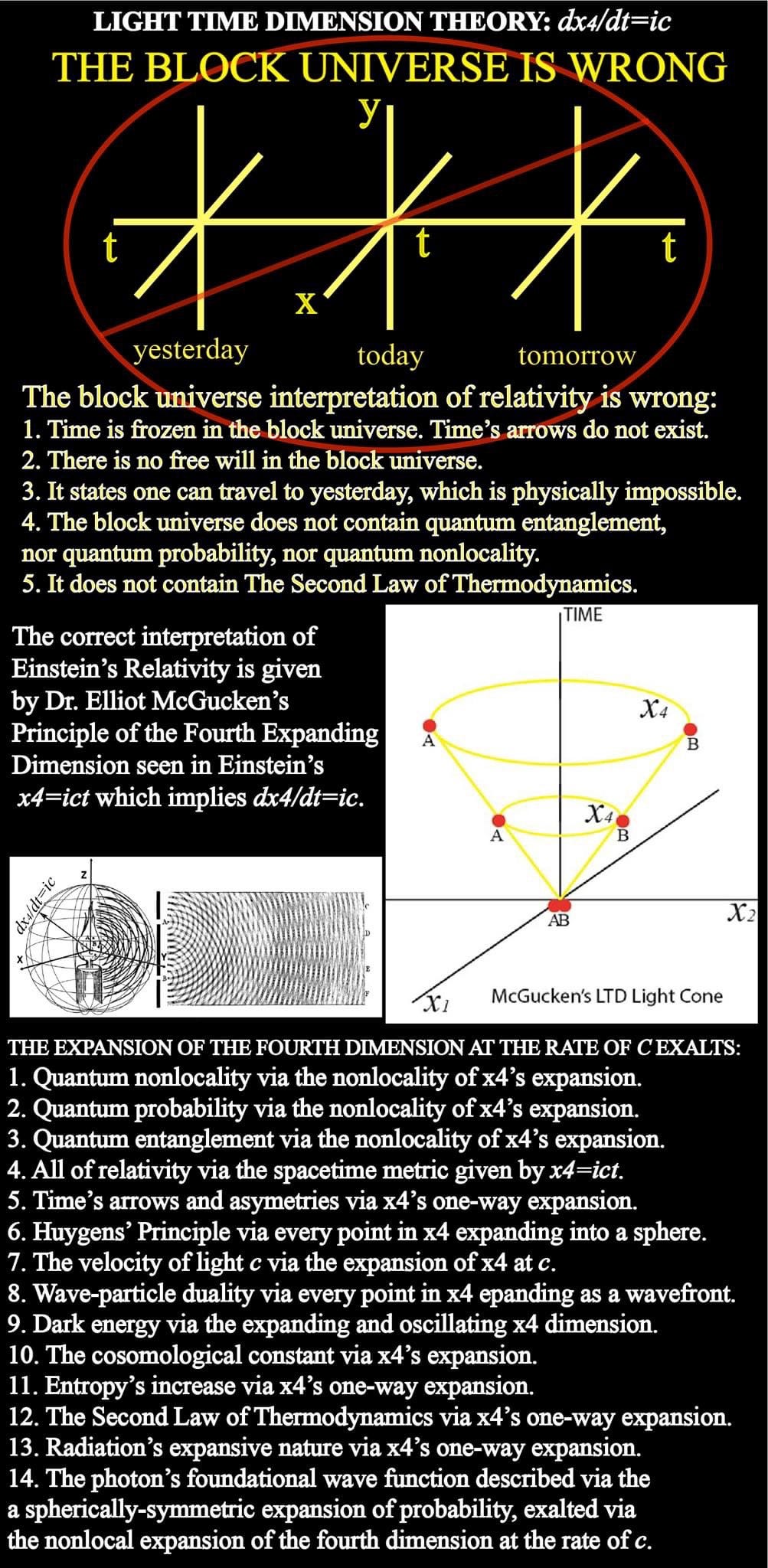
And it turns out that this very same *physical* mechanism of a fourth expanding dimension also accounts for special and general relativity, time and all its arrows and asymmetries, and the second law of thermodynamics, as well as quantum probability, which is shown to walk hand-in-hand with quantum nonlocality and entanglement.
Albert Einstein: A theory is the more impressive the greater is the simplicity of its premises (dx4/dt=ic), the more different are the kinds of things it relates (relativity, the quantum, time, dark matter, dark energy, entanglement) and the more extended the range of its applicability.
Sir Isaac Newton: Truth is ever to be found in simplicity (dx4/dt=ic), and not in the multiplicity and confusion of things (string theory’s 40+ dimensions, multiverse mania).
Albert Einstein: Any intelligent fool can make things bigger (the multiverse), more complex (the string theorists’ landscape), and more violent (the multiverse televangelist’s violence against simple Truth and Beauty). It takes a touch of genius—and a lot of courage—to move in the opposite direction (dx4/dt=ic).
Recently the LIGO/VIRGO collaboration detected the existence of gravitational waves, thusly affirming Einstein’s predictions that the geometry of the space-time dimensions bend, curve, and move. Einstein’s general relativity showed that space-time was not just a stage, but that it was part of the performance, as it too could move in arbitrary manners.
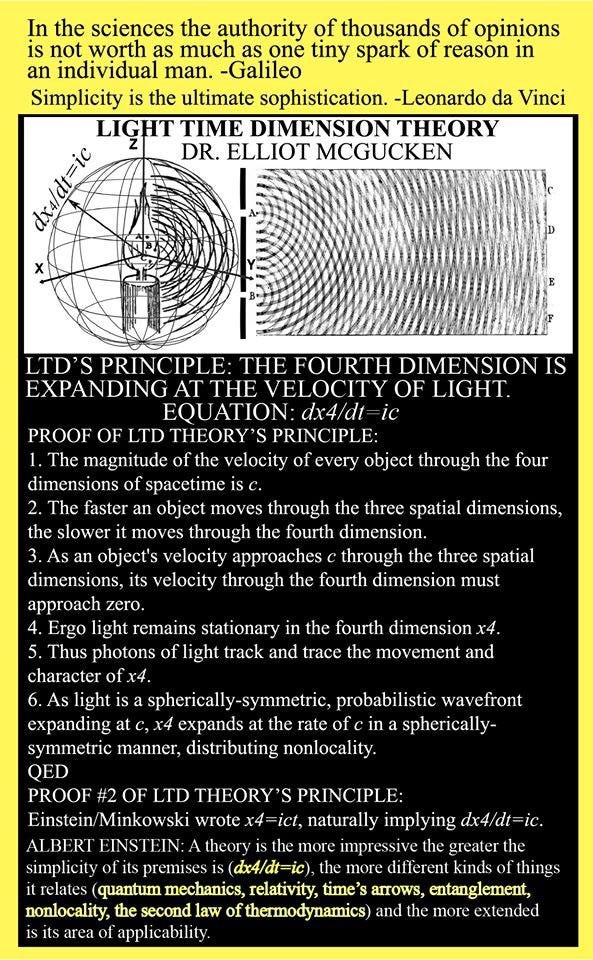
Gravitational waves propagate via undulations of space and time. LTD Theory builds upon this firm foundation of mobile dimensions by postulating and proving that the fourth dimension is expanding at the rate of c relative to the three spatial dimensions, as given by x4=ict which naturally implies dx4/dt=ic.
 The McGucken Principle: The fourth dimension x4 is expanding at the velocity of light c: x4=ict, ergo dx4/dt=ic
Leave a comment