Einstein Light Cone Spacetime Sculptures Photography and The Proof of Light, Time, Dimension Theory’s Principle dx4/dt=ic : The McGucken Principle and Equation
Einstein Light Cone Spacetime Sculptures Photography and The Proof of Light, Time, Dimension Theory’s Principle dx4/dt=ic
Dr. Elliot McGucken
McGucken Fine Art, www.emcgucken.com, goldennumberratio@gmail.com
Abstract
As an award-winning, fine art landscape photographer and Ph.D. physicist, I have been traveling throughout the beautiful, monumental deserts of the American Southwest and creating gargantuan Einstein Light Cone Spacetime Sculptures celebrating the equivalence of space and time first set down in Poincaré’s, Minkowski’s, and Einstein’s x4=ict. And too, the spacetime sculptures also celebrate my own representation of the equation x4=ict as dx4/dt=ic, from which a most natural postulate follows — the fourth dimension is expanding at the velocity of light c relative to the three spatial dimensions. A simple proof of this principle is presented. Not only is all of relativity readily derived from this foundational postulate of a fourth expanding dimension, but we finally realize a physical foundation for time and all its arrows and asymmetries, entropy’s one-way direction, and quantum nonlocality, probability, and entanglement. An early version of this physics-art project was reported on in the Smithsonian Magazine[i] in an article titled, “This Physicist Uses Drones to Create Giant Light Cones in the Desert.” All of this and more may also be found in my books: https://www.amazon.com/s?k=mcgucken+physics and my photography: https://www.emcgucken.com/Einsteins-Light-Cones-Spacetime-Sculptures-Elliot-McGucken
Introduction
Einstein: The greatest scientists are always artists as well.
Ansel Adams (legendary landscape photographer of the American West): A great photograph is one that fully expresses what one feels, in the deepest sense, about what is being photographed.
McGucken Light Cone Spacetime Sculpture, Long Exposure Photograph & Drone in Utah Desert
Einstein’s Light Cone in his book The Meaning of Relativity

Artists and Scientists — Choose Only One Master — Nature.
Einstein: The most beautiful thing we can experience is the mysterious. It is the source of all true art and science.
The legendary renaissance painter Rembrandt van Rijn advised aspiring artists to, “Choose only one master — Nature.” Einstein also looked towards nature for enlightenment, advising scientists to, “Look deep into nature, and then you will understand everything better.” All too much of modern art and science have lost touch with nature’s Truth and Beauty, and so it is that I created my Light Cone Spacetime Sculptures upon nature’s exalted easel, so as to celebrate the foundational truths of the equivalence of space and time and the expansion of the fourth dimension at the rate of c as given by x4=ict, which I rewrite as dx4/dt=ic. Einstein turned towards Galileo in celebrating the central importance of observing nature directly, stating, “Propositions arrived at by purely logical means are completely empty as regards reality. Because Galileo saw this, and particularly because he drummed it into the scientific world, he is the father of modern physics — indeed, of modern science altogether.”

Figure 2: Light Cones Spacetime Sculptures: White Pocket, Arizona
Einstein noted, “After a certain high level of technical skill is achieved, science and art tend to coalesce in esthetics, plasticity, and form. The greatest scientists are always artists as well,” and so it is that just as Minkowski’s simple picture of the light cone (seen in Figure 3 below) lead to General Relativity, it also naturally leads us to the expansion of the fourth dimension at the rate of c. The famous poet Edna St. Vincent Millay noted “Euclid alone has looked on Beauty bare,” and so, in the spirit of Newton’s Principia and Einstein’s relativity which advanced science via exalted Euclidean logic, I will present a proof of the expansion of the fourth dimension also exalting Euclidean logic.
All too often modern physicists spend as little time honoring Euclid’s, Einstein’s, and Newton’s methods as they spend contemplating nature firsthand alone in the wilderness, and so it is, that as so many note, postmodern theoretical physics and art hath lost their way. I hope my science and art serve as humble, yet powerful, beacons in the night.
The very first known illustrations of the light cone — Minkowski’s original 1908 drawings based on his spacetime metric and the treatment of time as a dimension with Minkowski’s x4=ict — were artistic in their own right as seen in Figure 3 here:
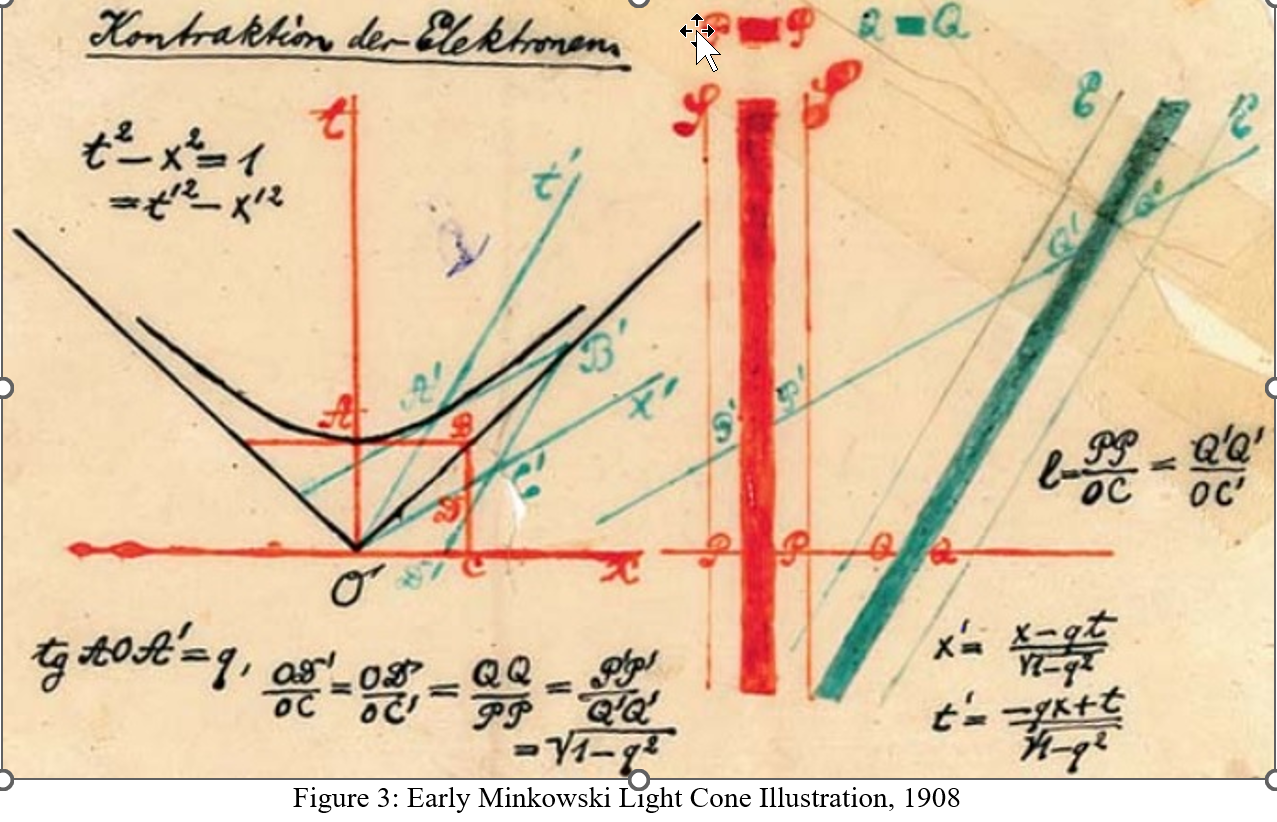
Minkowski used the above figure in his 1908 lecture titled “Space and Time”[ii] delivered at the 80th Assembly of German Natural Scientists and Physicians, whence he declared:
The views of space and time which I wish to lay before you have sprung from the soil of experimental physics, and therein lies their strength. They are radical. Henceforth space by itself, and time by itself, are doomed to fade away into mere shadows, and only a kind of union of the two will preserve an independent reality.
The light cone celebrates the equal footing of space and time found in the spacetime metric. And the spacetime metric, and thus all of relativity, may be derived from the simple introduction of a fourth dimension defined by x4=ict. The famous mathematical physicist Hermann Weyl noted that all of relativity derives from this four dimensional metric arising from x1, x2, x3, x4=ict, writing in his book Space, Time, Matter[iii]:
The solution of Einstein, which at one stroke overcomes all difficulties, is then this: the world is a four-dimensional affine space whose metrical structure is determined by a non-definite quadratic form Q(x) = (xx) which has one negative and three positive dimensions. All physical quantities are scalars and tensors of this four-dimensional world, and all physical laws express invariant relations between them.
The below screenshot from Einstein’s The Meaning of Relativity[iv] (now public domain) captures the concise brilliance of the introduction of the light cone in the context of the spacetime metric and Minkowski’s x4=ict, from which all of relativity derives. Thus, as all of relativity is found in the 4D spacetime metric, it could be said that all of relativity may be found in the light cone, which is drawn under the spacetime metric in Einstein’s book:
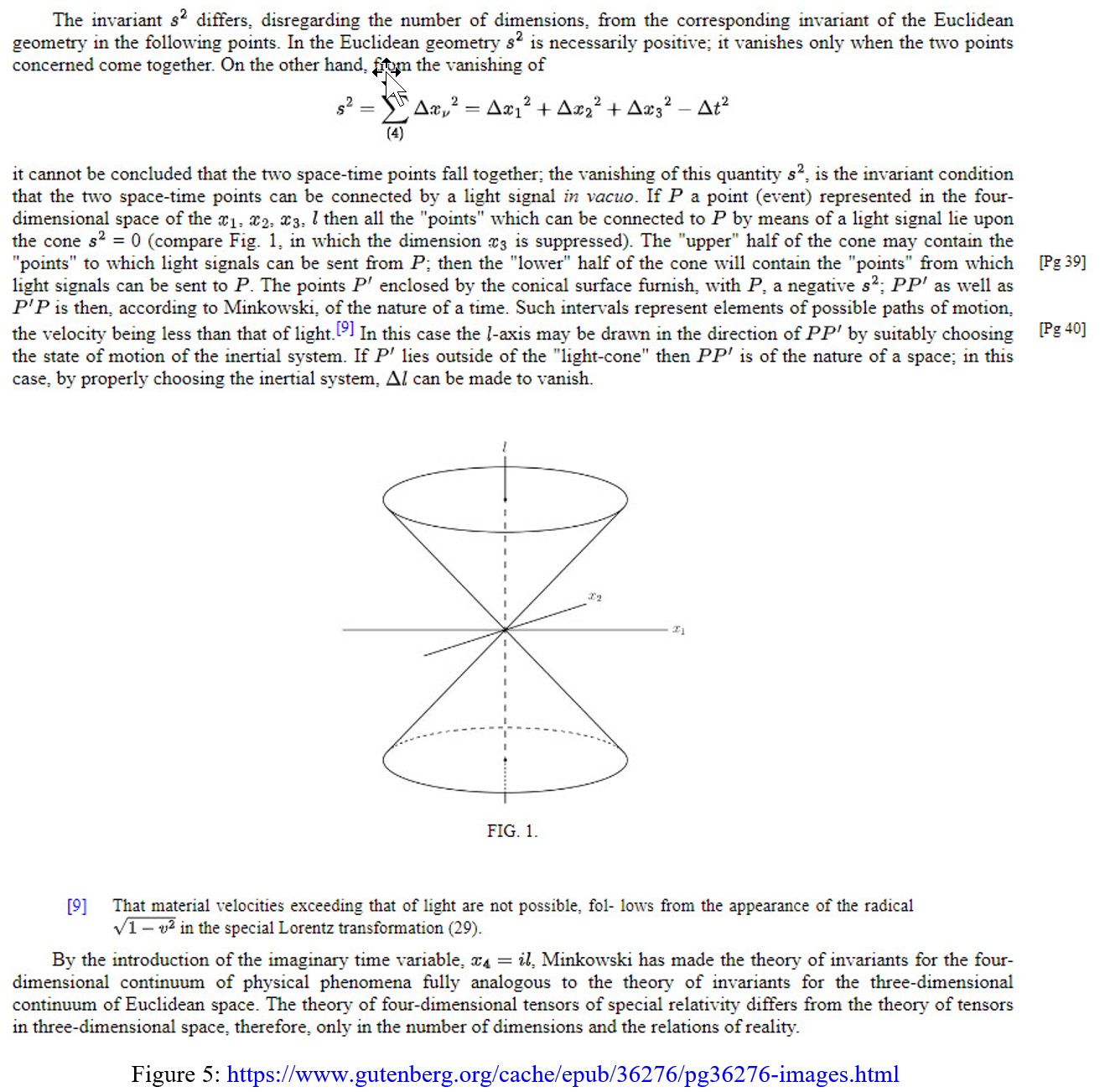
As seen above, Einstein concludes the section with:
By the introduction of the imaginary time variable, (x4=ict), Minkowski has made the theory of invariants for the four-dimensional continuum of physical phenomena fully analogous to the theory of invariants for the three-dimensional continuum of Euclidean space. The theory of four-dimensional tensors of special relativity differs from the theory of tensors in three-dimensional space, therefore, only in the number of dimensions and the relations of reality.
Furthermore, in his wonderful book Relativity: The Special and General Theory[v], Einstein shared the central importance of Minkowski’s equation x4=ict in the development of general relativity, writing:
In order to give due prominence to this relationship, however, we must replace the usual time co-ordinate t by an imaginary magnitude ict proportional to it. Under these conditions, the natural laws satisfying the demands of the (special) theory of relativity assume mathematical forms, in which the time co-ordinate plays exactly the same role as the three space co-ordinates. Formally, these four co-ordinates correspond exactly to the three space co-ordinates in Euclidean geometry. It must be clear even to the non-mathematician that, as a consequence of this purely formal addition to our knowledge the theory perforce gained clearness in no mean measure.
These inadequate remarks can give the reader only a vague notion of the important idea contributed by Minkowski. Without it the general theory of relativity, of which the fundamental ideas are developed in the following pages, would perhaps have got no farther than its long clothes.
GPS Leverages Relativity and Guides the Drone Celebrating Relativity
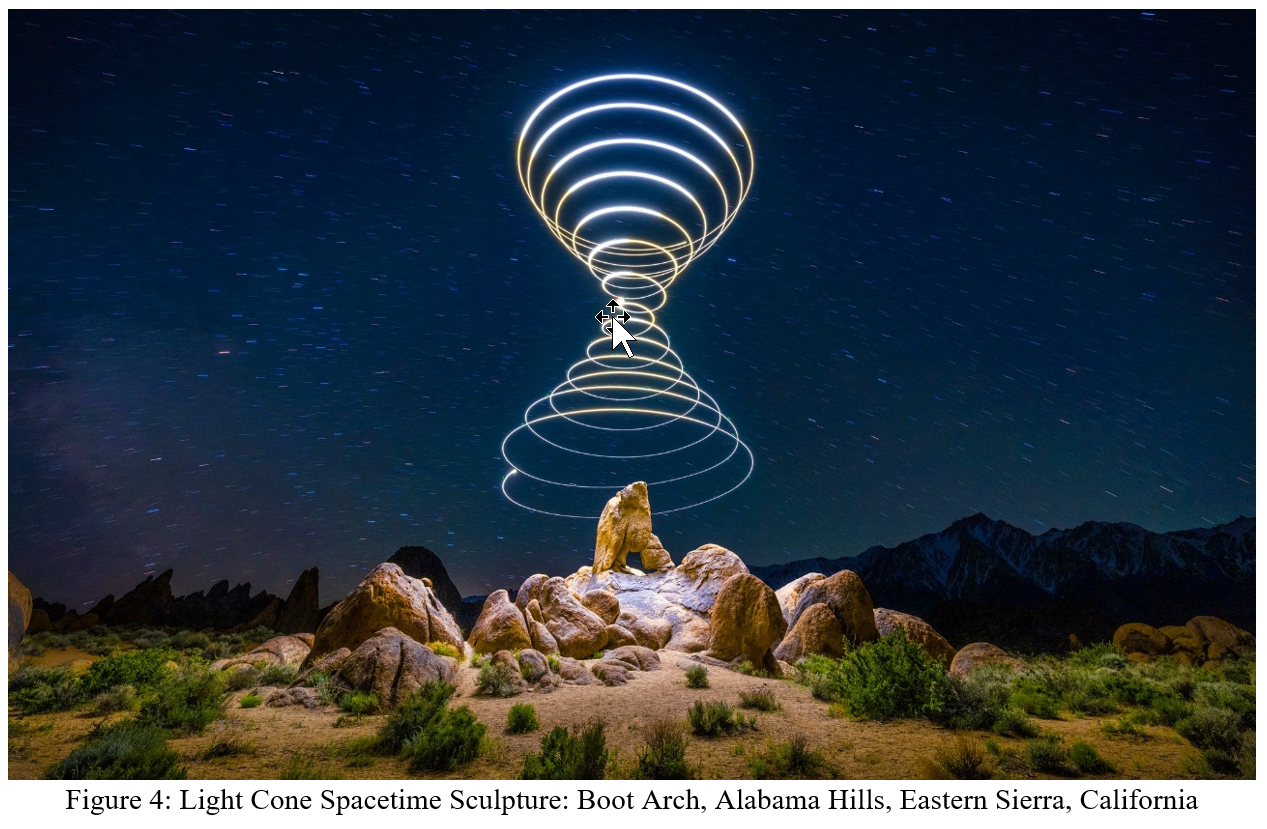
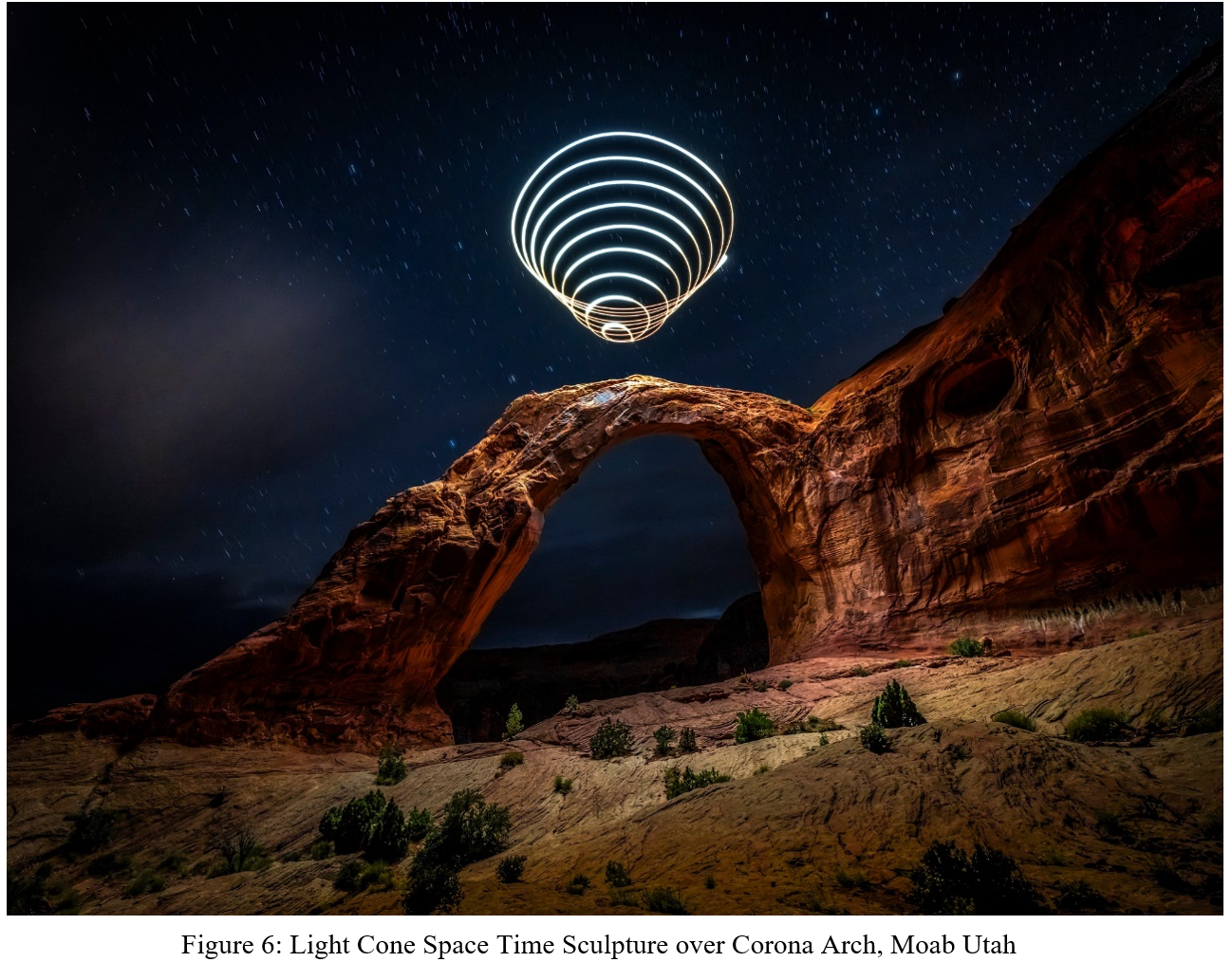
Photography literally means “light writing” and the light cone photographs celebrate light, space, and time via long, three-minute exposures of a spiraling drone, also sometimes capturing the motion of the stars behind the light cone via star-trails, clear skies permitting.
The drone is guided by GPS (Global Positioning Satellites) along its pre-programmed spirals. GPS celebrates the vast success of both special and general relativity whence the satellite’s clocks must be adjusted due to the relativistic effects of both their higher velocities (special relativity) and lower gravitational fields (general relativity) when compared with earthbound clocks.
And so it is that the GPS-guided light cone spirals themselves offer experimental evidence of not only Einstein’s relativity but the equivalence of space and time as defined by x4=ict and the expansion of the fourth dimension as presented in dx4/dt=ic:

Figure 7: Light Cone Space Time Sculpture: Laguna Beach, California
Thought and Ideas — Principles and Postulates — Lead the Way in Physics
In his book The Evolution of Physics[vi], Einstein noted that it is not mere math that leads the way in the advancement of physics, but rather, it are physical thoughts founded upon physical ideas such as, “Every action has an equal and opposite reaction,” and “The velocity of light is constant for all observers,” and “The fourth dimension is expanding at the rate of c,” which lead the way. Einstein writes:
Fundamental ideas play the most essential role in forming a physical theory. Books on physics are full of complicated mathematical formulae. But thought and ideas, not formulae, are the beginning of every physical theory. The ideas must later take the mathematical form of a quantitative theory, to make possible the comparison with experiment.
The fundamental physical idea underlying all of relativity, as Minkowski marveled at in his 1908 lecture/paper Space and Time[vii], (and as all too many physicists no longer marvel at), is:
We can clothe the essential nature of this postulate in the mystical, but mathematically significant formula
And right there Minkowski is stating that space is equivalent to time, while deeming the simple formula both “mystical” and “mathematically significant!” The light cone, first presented by Minkowski in that very same paper/lecture Space and Time, places space and time on equal footing.
What is the physical meaning of x4=ict? Never Lose a Holy Curiosity — Einstein.
Einstein: The important thing is not to stop questioning. Curiosity has its own reason for existing. One cannot help but be in awe when he contemplates the mysteries of eternity, of life, of the marvelous structure of reality. It is enough if one tries merely to comprehend a little of this mystery every day.
While Planck treated E=hf as a mere mathematical relationship, Einstein asked, “What is the physical meaning of E=hv?”, thusly launching quantum mechanics. Now that we see that space and time are of the same essence, we must ask, but how are space and time different? And so it is that I propose that while space x1, x2, and x3 and time x4 are all dimensions, the fourth dimension x4 is moving at the rate of c relative to the three spatial dimensions. This paper concludes with a proof of my most natural principle.
Art Exalting the Landscapes and Science
The legendary photographer Ansel Adams noted, “Some photographers take reality as the sculptors take wood and stone and upon it impose the dominations of their own thought and spirit. Others come before reality more tenderly and a photograph to them is an instrument of love and elevation.”
While the vast majority of my landscape photography leans towards capturing the glory of the landscape as it is, the Light Cones Spacetime Sculptures project allows me to “take reality as the sculptors take wood and stone and upon it impose the dominations of my own thought and spirit.” I previsualize the light cone hovering over the landscape in my mind’s eye, and I then set forth to render it real, dialing in all the proper settings into the drone and camera alike, making adjustments over an entire week visiting the same scene, all the while seeking the perfect shot. My art celebrates my proof:
The Proof of Light, Time, Dimension’s Principle: x4 expands at c: dx4/dt=ic
Proof of Light Time Dimension Theory’s Principle: The fourth dimension is expanding at the rate of c relative to the three spatial dimensions, as given by Einstein’s x4=ict which means exactly this: dx4/dt=ic.
Proof of the McGucken Principle — The Fourth Dimension is Expanding at c:
1. The magnitude of the velocity of every object through the four dimensions of spacetime is c.
2. The faster an object moves through the three spatial dimensions, the slower it moves through the fourth dimension.
3. As an object’s velocity approaches c through the three spatial dimensions, its velocity through the fourth dimension must approach zero.
4. Ergo light remains stationary in the fourth dimension x4.
5. Thus photons of light track and trace the movement and character of x4.
6. As light is a spherically-symmetric, probabilistic wavefront expanding at c, x4 expands at the rate of c in a spherically-symmetric manner, distributing locality into nonlocality, augmenting entropy, and powering time’s arrows.
QED
Proof #2 of the McGucken Principle:
Poincaré/Einstein/Minkowski wrote x4=ict, naturally implying dx4/dt=ic.
Summary and Conclusions
And so it is that we venture out into nature to exalt that higher art celebrating nature’s secrets — both heralded and hitherto unheralded. Einstein taught us to never stop questioning, writing: “The important thing is not to stop questioning. Curiosity has its own reason for existing. One cannot help but be in awe when one contemplates the mysteries of eternity… Never lose a holy curiosity.” As I stood out there on blustery desert nights, I asked, “How could it be that space and time are of the same essence, and yet so different? And what is the physical meaning of x4=ict?” And I by and by I saw the light — the fourth dimension was the same as the three spatial dimensions, except it was expanding at the rate of c in a spherically symmetric manner, giving rise to not only relativity as we saw above, but to time and all its arrows and asymmetries, quantum nonlocality, entanglement, and probability, and the second law of thermodynamics which demands that entropy always increases. Please enjoy more Light Cone spacetime sculptures here: https://www.emcgucken.com/Einsteins-Light-Cones-Spacetime-Sculptures-Elliot-McGucken And please enjoy more “Light, Time, Dimension Theory dx4/dt=ic” physics in my books:
https://www.amazon.com/s?k=mcgucken+physics
[i] [1] W. Sullivan. “This Physicist Uses Drones to Create Giant Light Cones in the Desert”, June 22, 2023, Smithsonian Magazine, https://www.smithsonianmag.com/smart-news/this-physicist-uses-drones-to-create-giant-light-cones-in-the-desert-180982250/
[ii] [2] H. Minkowski. “Space and Time” (1920), A Lecture delivered before the Naturforscher Versammlung (Congress of Natural Philosophers) at Cologne — (21st September, 1908), https://en.wikisource.org/wiki/Translation:Space_and_Time
[iii] [3] H. Weyl. Space, Time, Matter, METHUEN&CO.LTD. 36 ESSEX STREET W.C. LONDON, 1922
[iv] [4] A. Einstein. The Meaning of Relativity, Four Lectures Delivered at Princeton University with Four Diagrams, May, 1921, Princeton, Princeton University Press 1923
[v] [5] A. Einstein. Relativity: The Special and the General Theory, Methuen & Co Ltd, 1920
[vi] [6] A. Einstein, L. Infeld. The Evolution of Physics, 1938 by Cambridge University Press, https://www.simonandschuster.com/books/Evolution-of-Physics/Albert-Einstein/9780671201562
[vii] [7] H. Minkowski. “Space and Time” (1920), A Lecture delivered before the Naturforscher Versammlung (Congress of Natural Philosophers) at Cologne — (21st September, 1908), https://en.wikisource.org/wiki/Translation:Space_and_Time
 The McGucken Principle: The fourth dimension x4 is expanding at the velocity of light c: x4=ict, ergo dx4/dt=ic
Leave a comment